
Journal Your cycle
Signs your period is coming: 12 early clues, and how to know when

The short answer: the most common signs your period is coming are cramps, bloating, sore breasts, feeling tired, mood swings, food cravings and pimples. Most women notice them 1 to 2 weeks before their period. They usually go away a few days after bleeding starts. The best way to know when your period will come is to write down your period dates for 2 or 3 months.
You feel off. You’re tired, a little moody, and you want chocolate. Then your period shows up and it all makes sense.
This happens to almost everyone. More than 90% of women get at least some signs before their period, says the U.S. Office on Women’s Health. The good news: the signs follow a pattern. Once you know yours, your period stops taking you by surprise.
When do the signs start?
Your cycle has two halves. In the first half, your body gets ready to release an egg. That’s called ovulation. The second half goes from ovulation until your next period. Doctors call this second half the luteal phase.
Most pre-period signs show up in that second half. For most women, that’s about 1 to 2 weeks before the period. For some, it’s only a day or two before. When bleeding starts, the signs usually fade within a few days.

12 signs your period is coming
You probably won’t get all of them. Most women have a few signs that come back every month.
 Cramps
 Bloating
 Sore breasts
 Feeling tired
 Mood swings
 Anxious or teary
 Food cravings
 Pimples
 Headache or backache
 Upset stomach
 Bad sleep
 Foggy head
1. Cramps
A dull pain or tight feeling low in your belly. Some women feel cramps a day or two before their period. Others only feel them once bleeding starts.
2. Bloating
Your belly feels puffy and your jeans feel tight. Before your period, your body can hold on to more water. Bloating is often worst on the first day of your period, then it gets better.
3. Sore breasts
Your breasts may feel heavy, swollen or sore when you touch them. This is one of the most common signs.
4. Feeling tired
You want to go to bed early, even after a normal day. Feeling tired before your period is very common. Bad sleep can make it worse.
5. Mood swings
Small things bother you more than usual. You may feel grumpy, short-tempered or extra sensitive. For many women, this is the first sign they notice.
6. Feeling anxious, sad or teary
Some women feel nervous or worried. Others feel sad, or cry more easily. This usually gets better once your period starts.
7. Food cravings
You want chocolate, chips, or just more food than usual. Changes in hunger are a normal pre-period sign.
8. Pimples
Pimples often pop up on the chin and jaw the week before a period. If you get the same pimples at the same time every month, that’s your pattern.
9. Headache or backache
Some women get headaches before their period. Others feel pain in their lower back, often with cramps.
10. Upset stomach
You may have gas, loose stools or a hard time going to the bathroom. It’s not fun, but it’s normal around your period.
11. Bad sleep
It can be harder to fall asleep or stay asleep in the days before your period, even when you feel tired.
12. Foggy head
It’s harder to focus or remember things, or you drop things more than usual. This is a real pre-period sign. You’re not imagining it.
Your signs are your own. One woman always gets pimples and cravings. Another always feels tired and teary. When you know which signs you get, and when they start, you can see your period coming days ahead.
Is my period coming in a week, or tomorrow?
There’s no exact countdown. But many women notice signs in this order:
- About a week before: mood changes, sore breasts, cravings, pimples, feeling tired.
- A day or two before: more bloating, cramps starting, lower back pain, upset stomach.
- When bleeding starts: most signs go away within a few days.
Your order may be different. Write down which signs come first, and how many days before your period. After a few months, you’ll have your own countdown.
Period signs, but no period?
Sometimes the cramps and bloating show up, but your period doesn’t come on the day you expected. Here’s what to know:
- Cycles change. A normal cycle can be anywhere from 24 to 38 days, says the U.S. Office on Women’s Health. It can also change from one month to the next. A period that comes a few days late is common.
- 28 days is just an average. A 2019 study looked at more than 600,000 cycles. The average was 29.3 days, not 28.
- Early pregnancy can feel like PMS. Sore breasts, feeling tired and cramps can be signs of both. If you could be pregnant and your period is late, take a pregnancy test. It’s the only sure way to know.
- See a doctor if you don’t get a period for 3 months (and you’re not pregnant or breastfeeding), or if your cycles are often shorter than 24 days or longer than 38 days.
How to know exactly when your period is coming
Signs give you a hint. Your past periods give you a date. Here’s how:
- Write down the first day of every period. That’s day 1 of your cycle. After 2 or 3 months, you’ll know how long your cycle usually is.
- Write down your signs, and the day they start. For example: “Sore breasts on day 22. Cramps on day 27.” After a few months, you’ll see the same signs on the same days.
- Count forward. Take the first day of your last period and add your usual cycle length. That’s your best guess for your next period.
Doctors do the same thing. If you ever see a doctor about PMS, they’ll ask for a list of your signs and the dates of your last periods.
How ela helps
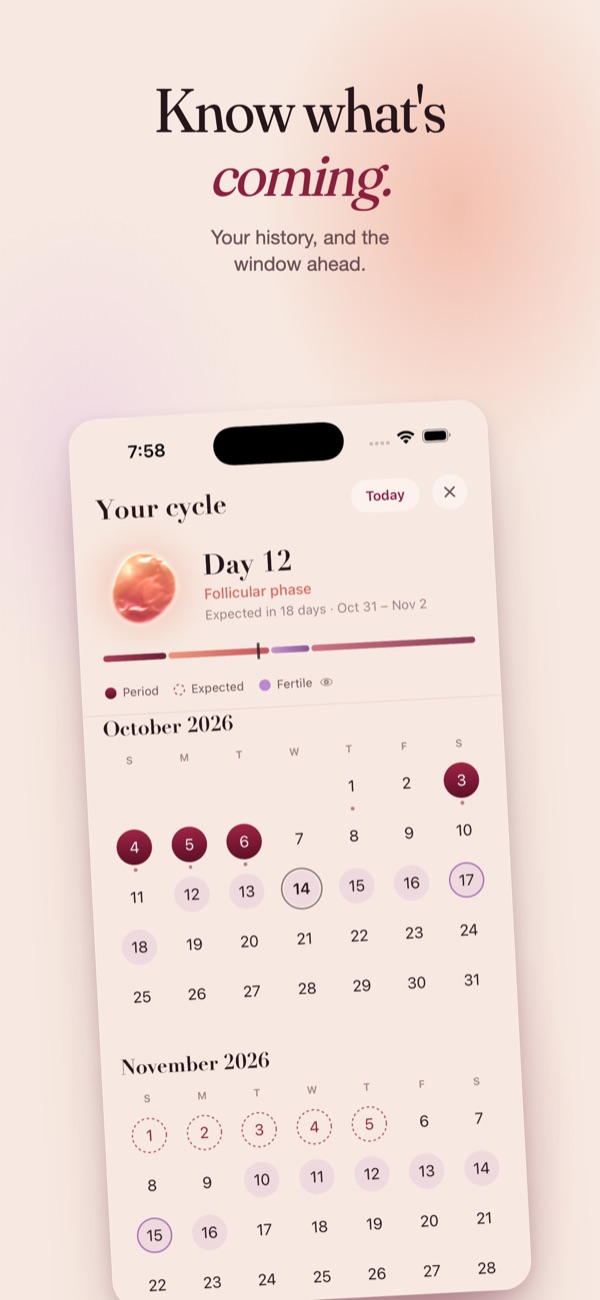
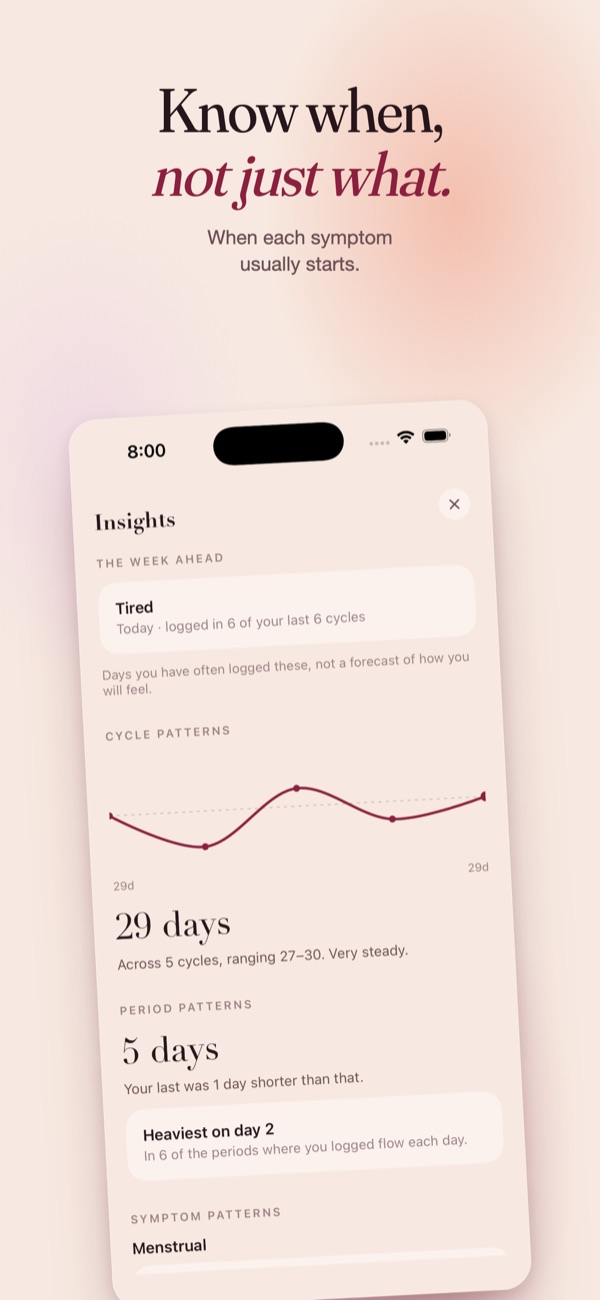
ela does the counting for you. Tap the day your period starts, tap the signs you feel, and ela learns your pattern. It shows when your next period is likely to come, and which signs you usually get in the days before. Your data stays on your iPhone, and you don’t need an account. See how ela works →
What can help in the days before your period
The U.S. Office on Women’s Health suggests a few simple habits that help many women:
- Move your body all month long, not only when you feel bad. A walk counts.
- Have less caffeine, salt and sugar in the 2 weeks before your period. This may help with bloating and mood.
- Get enough sleep, about 8 hours a night.
- Do things that calm you, like a walk, yoga, writing in a journal or talking to a friend.
Just knowing your signs are coming helps too. A busy week feels easier when you know it’s the week you usually feel tired.
When to see a doctor
Signs before your period are normal. But they shouldn’t take over your life. Talk to a doctor or nurse if:
- Your signs make it hard to work, go to school or get along with people.
- You feel very sad, hopeless or anxious before your period. A stronger form of PMS, called PMDD, affects fewer than 5% of women. It can be treated.
- Your periods are very painful or very heavy, or you bleed for more than 8 days.
- Your cycle suddenly changes, or your period stops for 3 months.
Quick questions
How many days before your period do signs start?
For most women, 1 to 2 weeks before. Some only notice signs a day or two before. They usually go away a few days after bleeding starts.
What is the first sign your period is coming?
It’s different for everyone. Many women notice mood changes, sore breasts or cravings first. Track your signs for a few months to find your first sign.
Can you have period signs and no period?
Yes. Cycles change in length, so your period may come a few days late. Early pregnancy can also feel like PMS. If your period is late and you could be pregnant, take a test.
Is it normal to feel emotional before your period?
Yes, very normal. Mood swings, feeling grumpy and crying more easily are some of the most common signs. If these feelings are very strong or make daily life hard, talk to a doctor.
How can I tell when my next period will come?
Write down the first day of your period for 2 or 3 months. Find your usual cycle length. Then count forward from your last period. A period tracker like ela does this for you.
Sources
- Premenstrual syndrome (PMS), U.S. Office on Women’s Health
- Your menstrual cycle, U.S. Office on Women’s Health
- PMS (premenstrual syndrome), Cleveland Clinic
- Real-world menstrual cycle characteristics of more than 600,000 menstrual cycles, Bull et al., npj Digital Medicine, 2019
This article is for general information only. It is not medical advice. If you’re worried about your health, talk to a doctor or nurse.